I’ve only ever had a passing knowledge of Ai Weiwei. The Chinese government hated him, I knew that much, and his contemporary art always seemed intended to irritate the powers that be even more – so much so, they took his passport for four years (the scoundrels). From a distance, he seemed humorous, genuine. Creative. Committed to his cause. Maybe even normal, for an artist. “You have a responsibility to make sure your language is clear”, he says on the audio commentary of his new show at the Royal Academy of Arts – and it’s that aspect of this latest survey that’s makes it a powerful, thought-provoking testimony of his life and work.
I spent last Friday afternoon checking it out with a friend. It was frustratingly crowded, which I guess is to be expected with blockbuster shows like this one – but once we dodged the school groups and the selfie sticks, we got the chance to appreciate pieces he created over the past 20 years (including some new ones, specifically for RA). He’s very good at corrupting traditions to make a case for human rights and creative freedom – and though it’s occasionally cheeky and disturbing, it’s unequivocally sincere.
The show’s worth a visit and on until 13th December and you can find out more about it here. In the meantime, check out some of my snaps from my recent visit below:

You probably already know that the mighty Frieze Art Fair kicked off on Monday – and though I’ll always have love for one of the world’s biggest shows of contemporary art, I’m usually more tempted to hit up the independent fringe gigs taking place around the same time. So here’s this weekend’s art crawl:
It’s now in its 6th year at the Old Truman Brewery and it’s where you go to see the edgier side of contemporary art. Tickets are only £8.80 too and I love how you can pay in GBP or Bitcoin (not that I have any, but still – that’s kinda dope.). www.monikerartfair.com
Held at Somerset House, the 1:54 is just a 3-year-old but it keeps going from strength to strength with its collection of diverse art that spans the African continent. Tickets are £15, but it’s not often you’ll come across this level of art celebrating African craftmanship, so it’s definitely worth a look around. 1-54.com/london
This show, which turns 10 this year, also holds court at the Old Truman Brewery and focuses on the rising stars in the art world – so works are not only affordable here (starting at £50), but you could be rubbing shoulders with the Next Big Thing who’ll be worth millions one day. Get that selfie AND an autograph. www.theotherartfair.com
The featured image is Mimi Cherono Ng’ok’s ‘Untitled, (No one but you, Dakar series)’, 2014, Inkjet print on cotton rag paper, edition of 6, 120 x 120 cm, Courtesy of Fondation Donwahi. Showing at this year’s 1:54.

I love pop art, so hitting up this show at the uber-modern The Centre Pompidou was a no-brainer. Jeff Koon is considered to be one of the world’s most expensive artists (his work can fetch for $25 million upwards) an he’s produced a collection of iconic and controversial pieces in the last 40 years, many which feature in this small retrospective. There’s the 1989 Made in Heaven piece of him and his wife, tha MJ and Bubbles sculpture and of course, the Balloon Dog (Magenta), which appears to be the show’s centrepiece and clearly a favourite amongst the visitors. It’s unbelievably metallic, but such is the incredible level of detail that you’ll be tempted to touch it to find out. While the show features plenty of fun stuff to take selfies with, one of my friends who came with me found it all a bit “meh”, and I could understand why – without
the Koon backstory, the work here is just a pick and mix of kitsch and quirky artwork without the meaning that comes from a more meticulously curated (or larger) show. Still, it’s a whistle-stop education in a contemporary American artist who, though a bit Marmite, does what he does quite well. Had we stayed a bit longer for our €13, it might have been worth checking out some of the other Pompidou exhibitions, including a Hervé Télémaque retrospective (on until 18th May) and the What Is Photography? exhibition, an exploration of the medium in modern times (on until 1st June). www.centrepompidou.fr/en/The-Centre-Pompidou (Nearest Metros: Rambuteau)


London-dwellers, you and I can count ourselves among more than 80% of the British population now living in urban areas. Our own beloved city is the most diverse of Britain’s urban centres, with over a third of its population born outside of the UK. With so many people on the move around an increasingly globalised world, cities and their cultural identities are changing at a faster rate than ever before. Does there remain any collective idea of the city itself? Alan Brooks’ third exhibition at MOT International’s London gallery space is an exploration of the concept of the city, our personal perceptions of it, and what it might mean to us to inhabit one today.
No less than one hundred drawings spread across a single black-painted wall of the small gallery. They vary in size and in content: images taken from gossip magazines and from newspapers are set beside floor plans and architectural drawings, and literary fragments sit with the toilet-wall scrawlings of an anonymous small-time vandal. Every one of them is carefully rendered in pencil crayon on paper – so we are told, but it’s hard to believe. Brooks deftly manipulates his simple materials to produce a startlingly broad range of effects to match the array of source materials on show.
Previous works by Brooks have exhibited the same eye-popping levels of labour. In his last show at MOTInternational, Brooks showed 48 pencilled portraits of an (all-male) selection of artists in front of their most famous artworks. Brooks was working from images of securely canonised, artist stars of the twentieth century and although his careful copies were technically impressive, they didn’t offer any new dimension to the sources. Brooks’ City, with its sprawling collection of cultural artefacts, is more open to interpretation.
Brooks was inspired by The City: A Vision in Woodcuts, a striking pictorial novel by Belgian engraver Frans Masereel. Masereel’s bold, chunky Expressionist prints are formally a world away from Brooks’ obsessive, tightly executed pencil drawings. However both artists are united in navigating a path through the infinite narratives and histories embedded in the urban environment, and attempting to capture what it is to live in a City. (Words: Florence Ritter)
Alan Brooks: City, MOT International is on until 30th March 2013. For more info, visit: http://www.motinternational.org/alan-brooks

Imagine multi-screen mixed media presentations fused with music and set in the dark – this is not the latest VJing event but a new exhibition on expanded cinema. This film movement, which came to prominence in Britain in the early 1970s, was conceived as an alternative to mainstream cinema. Expanded cinema films were experimental works that encompassed film, video, sound and performance. They were made as live projection events, often using 16mm projectors and almost always performed in the dark. Through these films, artists sought to challenge the conventions of spectatorship and the filmmaking process. On at the Camden Arts Centre, this group show has been curated by artist-filmmaker Guy Sherwin and includes both seminal works from the 1970s and more contemporary pieces.
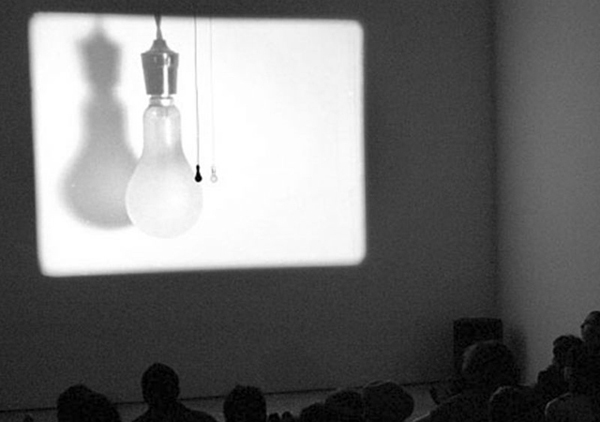
Anyone fortunate enough to have seen and experienced Filmaktion at Tate Modern recently will be familiar with the work of Malcolm Le Grice. Recognised as a major figure in the development of experimental film in the UK, Le Grice’s Castle 1 (1966) or ‘the light bulb film’ is a must-see at this show. Le Grice has said his ‘main interest is in creating experiences rather than concepts’ and this collaged film is just one of a number of works seeking to bring the cinematic experience consciously into the space of the audience. Le Grice’s unconventional use of sound in the editing process of this film cannot go without a mention. William Raban, Gill Eatherley and Annabel Nicolson – Le Grice’s Filmaktion contemporaries – are also represented in this exhibition not only by film but by text and images.
Original expanded cinema works were never produced for a gallery, in keeping with the movement’s radical intent they were shown in more unusual spaces – so several of the earlier films on view have been modified. An expanded cinema exhibition without any live performances possibly misses the point, so a programme of live events does feature throughout its run. There are those who’d argue that expanded cinema is all around us – we are quite used to seeing moving images in a gallery setting but these flicks really are pictures of a different kind. (Words: Eri Otite)
Film in Space is on at the Camden Arts Centre until February 24 2013. For more info, visit www.camdenartscentre.org