Tag: art

  • Something you should see… Manet: Portraying Life at Royal Academy of Arts

    Something you should see… Manet: Portraying Life at Royal Academy of Arts

    Edouard Manet is probably best known for his highly controversial painting Olympia, the scandalously and decidedly naked Parisian prostituée with her arresting gaze. But the woman depicted in Olympia is just one of a whole host of models who sat for the French nineteenth-century painter. This month, the Royal Academy of Art is putting on the first ever exhibition dedicated to Manet’s portraiture – and astonishingly (given the extensive curatorial coverage of the Impressionists) this has never been done before.

    Manet at Royal Academy of Arts

    Manet is recognised as the pioneer of the anti-academic style of the 1860s and he is widely celebrated for his paintings’ dialectical reflection on the conditions of industrial modernity. However, although Manet’s work is today the subject of a blockbuster exhibition, it was not always so well-received. Throughout his three decade-long career (cut short by his sudden death at 51) the artist endured repeated rejections from gallerists and an onslaught of damning reviews by prominent critics. Many works now considered masterpieces were then derided as tasteless and vulgar. His sitters – rich young girls and their governesses, fellow artists, friends and family – are painted neither idealistically nor satirically, but as they might appear: in sunlit parks and in harbours, in bars and on the streets. Each gazes directly out to us. Manet instigated a much more intense relationship between sitter and beholder than that which had been previously attempted or achieved in painting. But the paintings’ lack of finesse repelled his critics who favoured the glossy, impenetrable surfaces of the work of some of Manet’s more commercially successful contemporaries.

    Manet at Royal Academy of Arts

    Nonetheless, with the support of his circle of literary and artistic friends, Manet persevered. Any struggling artists or students today who are going against the grain with projects that break the mould or unfashionably question the status quo should look to Manet. His is a success story in the face of critical adversity, and all with a little help from his friends. (Words: Florence Ritter) 

    Manet: Portraying Life runs until 14th April. For more info, visit: www.royalacademy.org.uk/exhibitions/manet

    A Date for the Diary:
    Manet is most commonly identified with the origins of Modernism and with the beginnings of Impressionism, but has also had a considerable impact on contemporary photographic portraits. Catch seminal photographer Rineke Dijkstra discuss his work in her talk on 8th March at the RA.

  • Something you should see… Schwitters in Britain at Tate Britain

    Something you should see… Schwitters in Britain at Tate Britain

    When Kurt Schwitters arrived in Britain as a refugee from Nazi Germany, he was already a key figure in European Dadaism. The work produced by the German artist during this time from 1940 until his death in Cumbria in 1948, is the subject of a major exhibition at Tate Britain. The show examines how Schwitters’ period in exile affected his style in the latter stage of his career.

    He’s is best known for the invention of ‘Merz’, which he defined as ‘the combination, for artistic purposes of all conceivable materials’. Essentially, this meant working with everyday materials and found objects (including litter) to produce art. First applied to the abstract collages he made from piecing together bits of string, bus tickets, newsprint, sweet wrappers and even pram wheels – this concept was extended by Schwitters to include all his artistic endeavours, from sculpture to poetry.

    Many of the pieces on display (over 150 in total) haven’t been shown in the UK for decades, so this really is an opportunity to see what many consider to be some of the most accomplished collages of the 20th century. An early example of Merz – look out for The Skittle Picture (1921) – will be amongst the collages, assemblages and sculptures on view. Also worth a scout has got to be Merz Barn – Schwitters’ last sculpture and installation before his death at Kendal.

    The legacy of the German’s British period is evident in the lasting impression he made on artists such as Eduardo Paolozzi and Richard Hamilton. His Dadaism in the form of Merz seemed to anticipate many later developments in art including Pop Art, installation art and the use of multimedia. Schwitters may not have received the recognition in Britain that he had enjoyed in mainland Europe but he certainly left his mark. (Words: Eri Otite)

    Schwitters in Britain is on at Tate Britain from 30 January – 12 May. For more info, visit www.tate.org.uk

  • Something You Should See… Sharon Kivland at DomoBaal

    Something You Should See… Sharon Kivland at DomoBaal

    Half-way into January and still feeling sluggish? Time to head to Holborn, where private gallery DOMOBAAL is showing new works by Sharon Kivland designed to stimulate our conscious and unconscious minds.

    Artist-writer Kivland is a Research Associate of the Centre for Freudian Analysis and Research in London, and Freudian theory permeates her thinking and shapes her work. In her series at DOMOBAAL, Kivland focuses on concepts of memory, unconscious desire, repression and the Uncanny. She draws upon a personally collated archive of postcards, magazine clippings, advertisements and prints, cropping them at unexpected angles, re-painting them and making laborious copies in carefully rendered pencil drawings. The impact of these alterations on the way the images are perceived is discussed in two new critical essays of Kivland’s work, written specifically for the exhibition and on show in limited-edition bound volumes.

    Dalida

    One of these discusses Kivland’s work in terms of the Uncanny. At once disturbing and alluring, the female is ‘always seductive and sublime, and yet ugly, beguiling and unsettling’. In her Les Vedettes series, Kivland alters picture postcards of flawless, sleek-necked stars of the silver screen by crudely brightening their teeth and eyes with flecks of gouache. ‘The postcards are slowly fading’ Kivland tells TCé. ‘One day (I imagine), only the lips and highlight in the eyes will remain.’ A haunting thought.

    Also look out for Kivland’s The Unconscious is a City, in which the artist has applied swathes of gouache in greyscale to rarely found 1950s picture postcards of Rome. Although irrevocably altering the image, Kivland keeps to the contours of the picture and the documents retain a visual memory of their original content. The series make for a wonderfully clear visual analogy for one for Freud’s lesser-known (and not fully formulated) theories of Rome as an analogy of memory, where past and present co-exist. However, they also encourage us to take a position as to the aesthetic decisions actioned by Kivland – are her rough daubings of paint the traces of a destructive, anarchic, even iconoclastic act? Or might they suggest a process of reincarnation, as Kivland retrieves an otherwise rather forgettable image from the confines of the archive? Time to get thinking. (Words: Florence Ritter) 

    Sharon Kivland at DomoBaal runs from January 18th – February 16th . For more info, visit: www.domobaal.com

  • Something you should see… Art of Angel at Angel tube station

    Something you should see… Art of Angel at Angel tube station

    The daily commute to and from work can make anyone stressed – peak hour travel on the London Underground anyone? So, in the absence of a Kindle, free paper or iPod – anything to brighten the mood has got to be welcomed. The Art of Angel exhibition is seeking to do just that (for the next two weeks anyway) by showcasing a selection of international artists throughout Angel tube station. Planned to coincide with the forthcoming London Art Fair, this show features a mix of urban and contemporary art – diverse in both style and technique on the station’s billboards.

    Art of Angel

    The aim to bring contemporary art to London’s harassed commuters and provide a new platform for artists to show their work is the main objective of Art Below – a London based public arts organistation. Founded in 2006, by brothers Ben and Simon Moore, the group has steadily created an alternative to the traditional art industry and gallery system. Exhibitions hosted by Art Below have taken over station platforms, lifts and escalators. Although primarily focused on emerging talent, Art Below has also collaborated with established artists including Banksy and Alison Jackson. Jackson’s mocked-up photo of a boxing match between President Obama and Republican candidate Mitt Romney could be seen at Regent’s Park station, last year.

    Art of Angel

    As the London Underground celebrates 150 years, it seems fitting that one of its stations is transformed into a very public art gallery. Nearly three million journeys are made on the Tube each day and for those passing through Angel that journey has just been made a little bit richer. (Words: Eri Otite)

    Art of Angel at Angel tube station is on until 28 January. For more info, visit www.artbelow.org.uk

  • Something you should see… Gerard Byrne: A state of neutral pleasure at the Whitechapel Gallery

    Something you should see… Gerard Byrne: A state of neutral pleasure at the Whitechapel Gallery

    In Paris in 1928, a group of Surrealist artists and writers held the first of a series of round-table discussions on eroticism. The loose collective included André Breton, Jacques Prévert and Yves Tanguy. Artist Gerard Byrne’s latest multi-screen installation recreating this event is set for its UK premiere at Whitechapel Gallery, as part of a major survey of his work. A man and a woman make love (2012) is just one of seven large-scale film installations included in this exhibition, which traces Byrne’s career over the last decade.

    Gerald Byrne

    Working primarily in film and photography, Byrne is known for his ambitious installations that reference historic events – some more earnest than others. Taking his title from a statement made by the sculptor Carl Andre, Byrne’s film – A thing is a hole in a thing it is not (2010), revisits key moments in the history of Minimalist art. This five-screen offering at the Whitechapel includes the reenactment of a1964 radio interview between US minimalist artists Frank Stella, Donald Judd and Dan Flavin.
    Yet with work on show that restages a 1960s Playboy article indicates that Byrne’s sources are certainly not all highbrow! Space at the Whitechapel will also be made for his ongoing photographic series Newstands – images of magazine displays at newsagents. His practice reveals a preoccupation with using history to help understand the present. His engagement with high and popular culture has resulted in a varied body of work that is well worth a view. (Words: Eri Otite)

    Gerard Byrne: A state of neutral pleasure is showing at the Whitechapel Gallery from 17 January – 8 March. For more info, visit www.whitechapelgallery.org

  • Something you should see… Film in Space at the Camden Arts Centre

    Something you should see… Film in Space at the Camden Arts Centre

    Imagine multi-screen mixed media presentations fused with music and set in the dark – this is not the latest VJing event but a new exhibition on expanded cinema. This film movement, which came to prominence in Britain in the early 1970s, was conceived as an alternative to mainstream cinema. Expanded cinema films were experimental works that encompassed film, video, sound and performance. They were made as live projection events, often using 16mm projectors and almost always performed in the dark. Through these films,  artists sought to challenge the conventions of spectatorship and the filmmaking process. On at the Camden Arts Centre, this group show has been curated by artist-filmmaker Guy Sherwin and includes both seminal works from the 1970s and more contemporary pieces.

    Film In Space

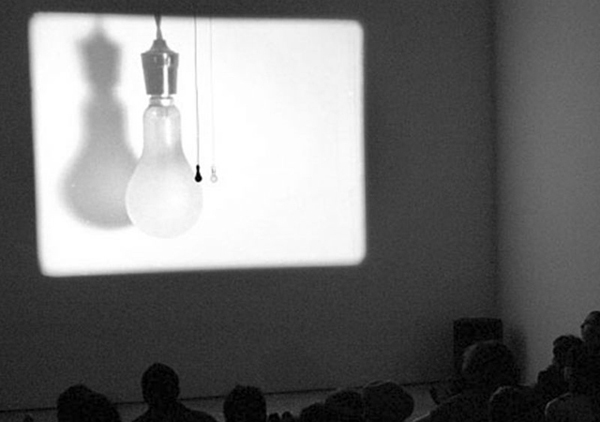
    Anyone fortunate enough to have seen and experienced Filmaktion at Tate Modern recently will be familiar with the work of Malcolm Le Grice. Recognised as a major figure in the development of experimental film in the UK, Le Grice’s Castle 1 (1966) or ‘the light bulb film’ is a must-see at this show. Le Grice has said his ‘main interest is in creating experiences rather than concepts’ and this collaged film is just one of a number of works seeking to bring the cinematic experience consciously into the space of the audience. Le Grice’s unconventional use of sound in the editing process of this film cannot go without a mention. William Raban, Gill Eatherley and Annabel Nicolson – Le Grice’s Filmaktion contemporaries – are also represented in this exhibition not only by film but by text and images.

    Film In Space

    Original expanded cinema works were never produced for a gallery, in keeping with the movement’s radical intent they were shown in more unusual spaces – so several of the earlier films on view have been modified. An expanded cinema exhibition without any live performances possibly misses the point, so a programme of live events does feature throughout its run. There are those who’d argue that expanded cinema is all around us – we are quite used to seeing moving images in a gallery setting but these flicks really are pictures of a different kind. (Words: Eri Otite)

    Film in Space is on at the Camden Arts Centre  until February 24 2013. For more info, visit www.camdenartscentre.org